
TCFD-Aligned Initiatives


The Company has established a governance framework, implemented risk management, set climate-related targets, and conducted scenario analyses in line with the recommendations of the Task Force on Climate-related Financial Disclosures (TCFD). Based on the results of these analyses, we incorporate climate-related considerations into our business strategy.
We will continue to contribute to the realization of a decarbonized society through environmentally responsible business activities while enhancing our corporate value.
Sustainability Promotion Framework
The MIRAINI Group has established a Sustainability Promotion Committee (chaired by the Representative Director, President, Executive Officer) under the supervision of the Board of Directors. Important matters discussed by this Committee are resolved by the Management Meeting and subsequently reported to the Board of Directors.
In business operations, the Management Meeting and the Sustainability Promotion Committee collaborate to deepen discussions on internal and external sustainability-related issues, thereby enhancing the effectiveness of management decisions and initiatives aligned with the Group’s business strategy.
In addition to discussing key sustainability policies, the Sustainability Promotion Committee will monitor the progress of working groups (composed of members from key departments, including our group companies) promoting each theme, thereby optimizing and ensuring the reliable implementation of sustainability measures in each of our group companies.
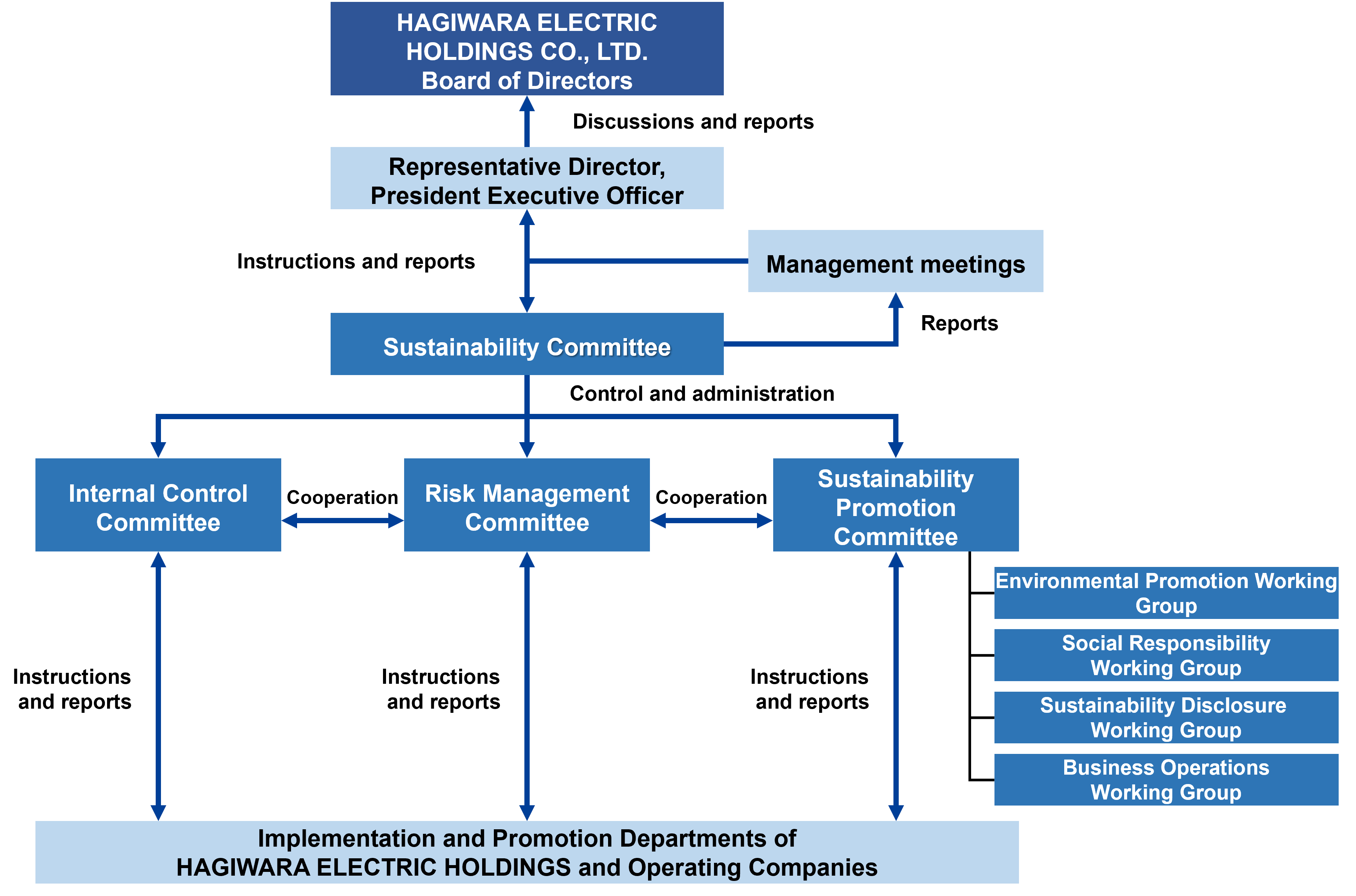
Roles of Each Organization
| Committee / Working Group | Role | Meeting Frequency |
|---|---|---|
| MIRAINI Holdings Sustainability Promotion Committee | Formulates and discusses sustainability management strategies based on the MIRAINI Group Sustainability Policy to promote the Group's sustainable growth and maximize corporate value. Reports its deliberations to the Management Committee. | Four times a year |
| Environmental Promotion Working Group | Reviews and recommends targets and initiatives for the Group's key environmental priorities in accordance with the MIRAINI Group Environmental Policy, and monitors and manages implementation progress. | |
| Social Working Group | Reviews and recommends targets and initiatives related to social contribution, human rights, and human capital, and monitors and manages implementation progress. | |
| Sustainability Disclosure Working Group | Shares and discusses sustainability disclosures and related activities among subject-matter experts, and monitors and shares information on emerging sustainability disclosure trends. | |
| Sustainability Business Working Group | Shares progress on business-related sustainability initiatives and sustainability information, and discusses the direction, objectives, and initiatives for promoting sustainability activities. |
Governance
As efforts toward the realization of a sustainable society continue to accelerate worldwide, and as expectations from our stakeholders for addressing social and environmental issues continue to grow, the MIRAINI Group recognizes sustainability as a key management priority. Among these issues, climate change is regarded as one of our most important management priorities, and we have continued to strengthen our initiatives and enhance our Group-wide management framework.
Following the establishment of MIRAINI Holdings in April 2026, we will continue our existing sustainability initiatives while further enhancing our governance structure to ensure more effective management and execution.
The MIRAINI Holdings Sustainability Committee serves as the principal body for discussing key sustainability initiatives and material sustainability matters. Based on its deliberations and recommendations, matters are submitted to the Management Committee and, where appropriate depending on their significance, to the Board of Directors for discussion and resolution. This governance framework enables the Board of Directors to provide appropriate oversight and guidance over the Group's sustainability initiatives.
MIRAINI Holdings recognizes climate change as one of its key management priorities and will continue to integrate and strengthen its climate-related initiatives in line with the recommendations of the TCFD.
Risk Management
To manage climate-related risks, the MIRAINI Group conducts scenario analyses with reference to external scenarios published by organizations such as the Intergovernmental Panel on Climate Change (IPCC) and the International Energy Agency (IEA). Based on these analyses, we identify and assess climate-related risks, evaluate their potential impact on each of our businesses, and consider industry trends to identify the most material risks and implement appropriate response measures.
The MIRAINI Group will continue to strengthen its processes for managing climate-related risks while further integrating climate-related risk management into the Group's enterprise risk management framework. Through these efforts, we will embed climate-related risks and opportunities into our business strategy and management decision-making.
Strategy
In accordance with the recommendations of the TCFD, the Company has conducted climate-related scenario analyses for its domestic operations. The analyses are based on the International Energy Agency (IEA) SDS*1 and NDCs*2 scenario, and assess both transition risks and opportunities arising from changes in policies and market trends, as well as physical risks and opportunities associated with climate change, including extreme weather events. Based on these analyses, we have identified material climate-related risks and opportunities, assessed their potential impacts on our business, and considered appropriate response measures.
We recognize that mitigating climate-related risks is essential to contributing to a sustainable society and achieving the Company's sustainable growth. Going forward, we will evaluate the financial impacts of each scenario, expand our scenario analyses to cover our overseas operations, and incorporate the results into our business planning and management strategy. Over the longer term, we aim to align our business with a 1.5°C scenario.
*1 SDS (Sustainable Development Scenario): A scenario developed by the International Energy Agency (IEA) that limits the increase in global average temperature to approximately 2°C above pre-industrial levels by the end of this century.
*2 NDCs (Nationally Determined Contributions): A scenario based on the achievement of greenhouse gas emission reduction commitments submitted by individual countries under the Paris Agreement.
Scenario Analysis Results
| Climate Scenario | Category | Key Risks and Opportunities | Potential Business Impact | Impact Level | Response Measures | ||
|---|---|---|---|---|---|---|---|
| 2°C | Transition Risk | Policy and Regulation | Risk | Higher carbon pricing (carbon taxes and ETS) | Increased operating costs driven by higher carbon pricing(carbon taxes and ETS) | High | • Although the impact of higher electricity procurement costs is currently expected to be limited, the Group will continue to evaluate all available options for reducing dependence on fossil fuels • As the share of renewable energy in commercial electricity supply increases, the cost of adopting green electricity is expected to decline. |
| Tighter CO₂ emission regulations | Increased power procurement costs driven by regulatory compliance with CO₂ emissions and rising demand for renewable energy | Low | |||||
| Opportunity | National carbon emission targets and policies | Revenue growth driven by the expansion of the green energy business (batteries, solar power, energy storage systems, etc.) | Low | Further expanding sales of power conditioners and energy storage systems to capture the growing demand for renewable energy and energy storage solutions in households and businesses | |||
| Revenue growth driven by expanding initiatives toward an energy-saving society | Investing in companies engaged in the development, manufacturing, and sales of next-generation power semiconductors, and expanding our product portfolio of related next-generation power semiconductor components | ||||||
| Technology | Risk | Shift toward more resource-efficient production and distribution processes | Increased capital expenditure (CAPEX) or operating costs to adopt resource, production, and distribution processes with lower carbon footprints (e.g., transitioning to Electric Vehicles) | Low | Further enhancement of logistics and transportation efficiency | ||
| Opportunity | Development and/or expansion of low-carbon products and services | Revenue growth driven by the successful development and commercialization of low-carbon products and services | High | ・Further expanding sales to the automotive industry by proposing and providing energy-efficiency improvement products (such as tire pressure monitoring solutions) and system solutions ・Further expanding sales to the dairy farming industry by proposing and providing energy-efficiency improvement products (such as feed tank level monitoring solutions) ・Expanding sales of products that adapt to climate change impacts, driven by our target to increase the sales ratio of SDGs-aligned products to 20% or more |
|||
| Market | Opportunity | Shifts in consumer and customer preferences and awareness | Revenue growth driven by expanding initiatives toward a sustainable society with higher climate consciousness | High | |||
| 3°C | Physical Risk |
Acute | Risk | Severity and frequency of natural disasters and extreme weather events (e.g., heavy rain, flooding, typhoons, water scarcity) | Lost sales opportunities due to disruptions in transportation networks and facilities caused by the increasing severity and frequency of natural disasters and extreme weather events (e.g., heavy rain, flooding, typhoons, water scarcity) | High | Although we currently have no major business sites heavily affected or damaged by natural disasters, we will continue to monitor their impact levels. Furthermore, when establishing new logistics centers or bases, we will carefully evaluate location and equipment layout by anticipating potential disaster damages. |
| Opportunity | Revenue growth from related products driven by rising demand for solutions that adapt to the impacts of more severe and frequent natural disasters (e.g., heavy rain, flooding, typhoons, water scarcity, landslides) | Low | Further expanding sales of our proprietary products (such as tilt sensors) designed for monitoring landslides caused by natural disasters | ||||
Metrics and Targets
Our baseline year for CO₂ emissions is fiscal year 2019 (FY2019), when we initiated our emissions calculations. Currently, our emissions data covers Scope 1 and Scope 2 emissions resulting from electricity and gasoline consumption within Japan. Following our transition to the new structure under the management integration, we will sequentially expand the boundary of our calculations to include our overseas bases and the entire Group, thereby promoting a global environmental management framework.
In FY2019, our Scope 1 and Scope 2 emissions totaled 952 t-CO2. Alongside our long-term goal of achieving net-zero emissions by FY2050, we set a medium-term target of "a 50% or greater reduction by FY2030 (compared to FY2019)." Thanks to progress in optimizing our business structure and upgrading our facilities—such as replacing older equipment with high-efficiency air conditioning and lighting—we successfully achieved this target ahead of schedule by FY2024.
Moving forward, while taking into account the expanded business scale and Scope boundary of the post-merger Group, we will maintain and build upon the reduction levels already achieved, and will continue to pursue the target of "a 50% or greater reduction" across our global operations. Furthermore, in alignment with our new medium-term business plan under the integrated structure, we will review and disclose more appropriate target metrics as necessary.
| FY2019 Result | FY2020 Result | FY2021 Result | FY2022 Result | FY2023 Result | FY2024 Result | |
|---|---|---|---|---|---|---|
| Scope 1&2 (Domastic) |
952 | 951 | 723 | 742 | 544 | 254 |